Key Differences Between EU, US, Middle East, and Asian Markets
Apr 6, 2025
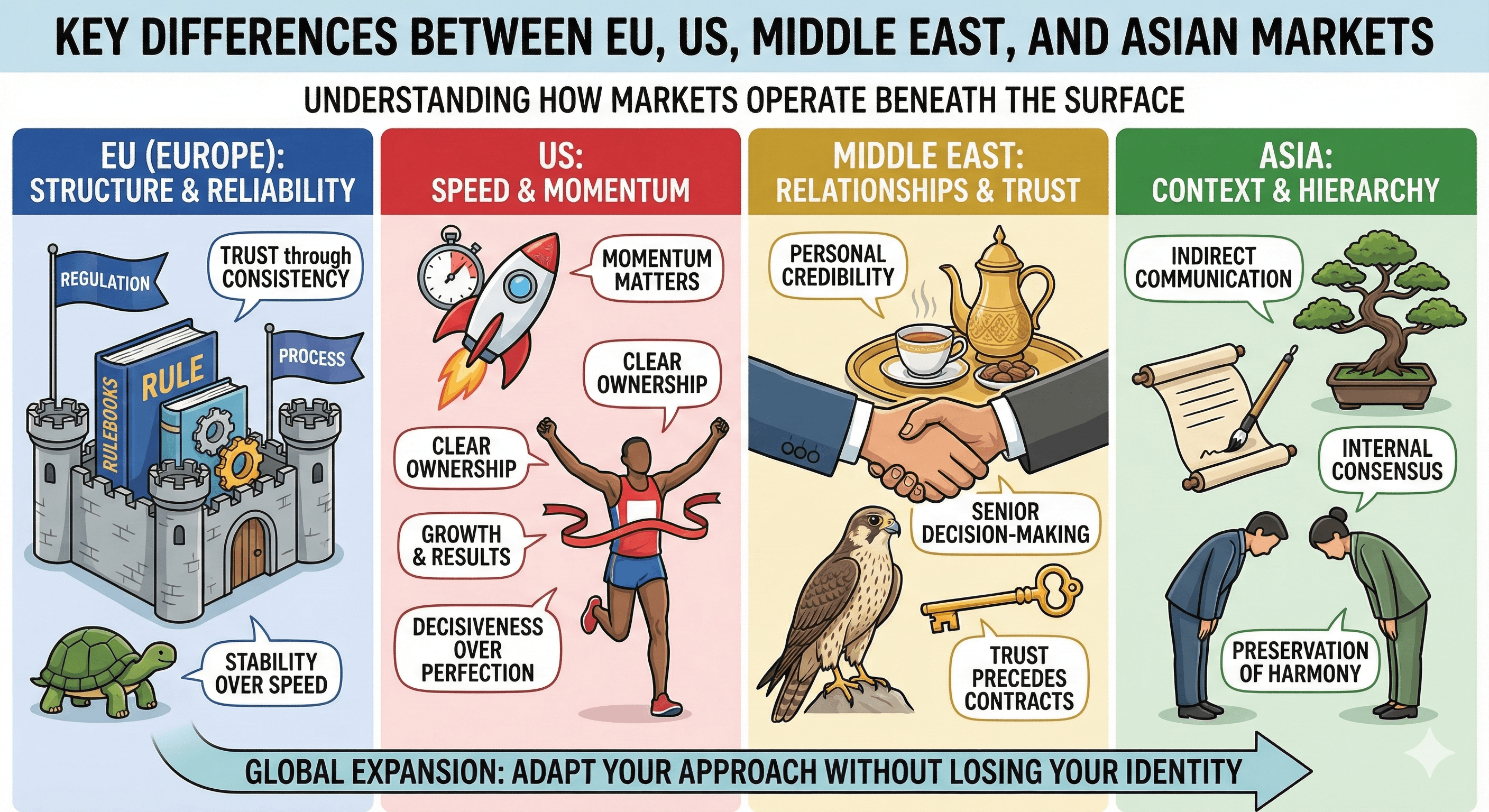
Key Differences Between EU, US, Middle East, and Asian Markets
When companies expand internationally, they often focus on surface-level differences such as regulations, language, and pricing.
What truly defines success, however, is understanding how markets operate beneath the surface.
Each region has its own commercial logic, expectations, and rhythm. Treating global markets as variations of the same model is one of the most common — and costly — mistakes companies make.
Europe (EU): Structure, Reliability, and Long-Term Orientation
European markets are known for:
Strong regulatory frameworks
Emphasis on process and documentation
High standards for quality and compliance
Business in the EU prioritizes:
Stability over speed
Alignment over individual decision-making
Long-term relationships over short-term gains
European buyers value predictability. Trust is built through consistency, not persuasion.
Common challenge for non-EU companies:
Underestimating the importance of structure and local alignment.
United States: Speed, Ownership, and Momentum
The US market is outcome-driven and fast-moving.
Key characteristics include:
Comfort with experimentation
Clear ownership of decisions
Strong emphasis on growth and results
American companies often value:
Speed as a signal of confidence
Decisiveness over perfection
Learning through action
Momentum matters. Companies that hesitate too long risk being overtaken.
Common challenge for EU companies:
Over-analyzing decisions and moving too slowly.
Middle East: Relationships, Trust, and Authority
Middle Eastern markets are built on relationships.
Key characteristics:
High importance of trust and personal credibility
Decision-making concentrated at senior levels
Long-term commitment once alignment exists
Business here is not transactional.
Trust precedes contracts.
Once relationships are established, decision-making can move very quickly.
Common challenge for Western companies:
Focusing on deals before investing in relationships.
Asia: Context, Hierarchy, and Indirect Communication
Asian markets are diverse, but many share common traits.
Key characteristics:
Respect for hierarchy
Indirect communication styles
High sensitivity to timing and context
Decisions often require:
Internal consensus
Careful sequencing
Preservation of harmony
Progress may appear slow externally, while alignment happens internally.
Common challenge for Western companies:
Misinterpreting indirect communication as lack of interest.
Final Thought
Each market rewards different behaviors.
Global expansion works best when companies adapt their approach without losing their identity.
Understanding regional differences isn’t a soft skill — it’s a strategic advantage.