How Decision-Making Differs Across Regions — And Why It Matters
Mar 28, 2025
Many global expansion challenges aren’t caused by bad strategy.
They’re caused by misaligned decision-making expectations.
Understanding who decides, how decisions are made, and when commitment is real is essential for predictable growth across borders.
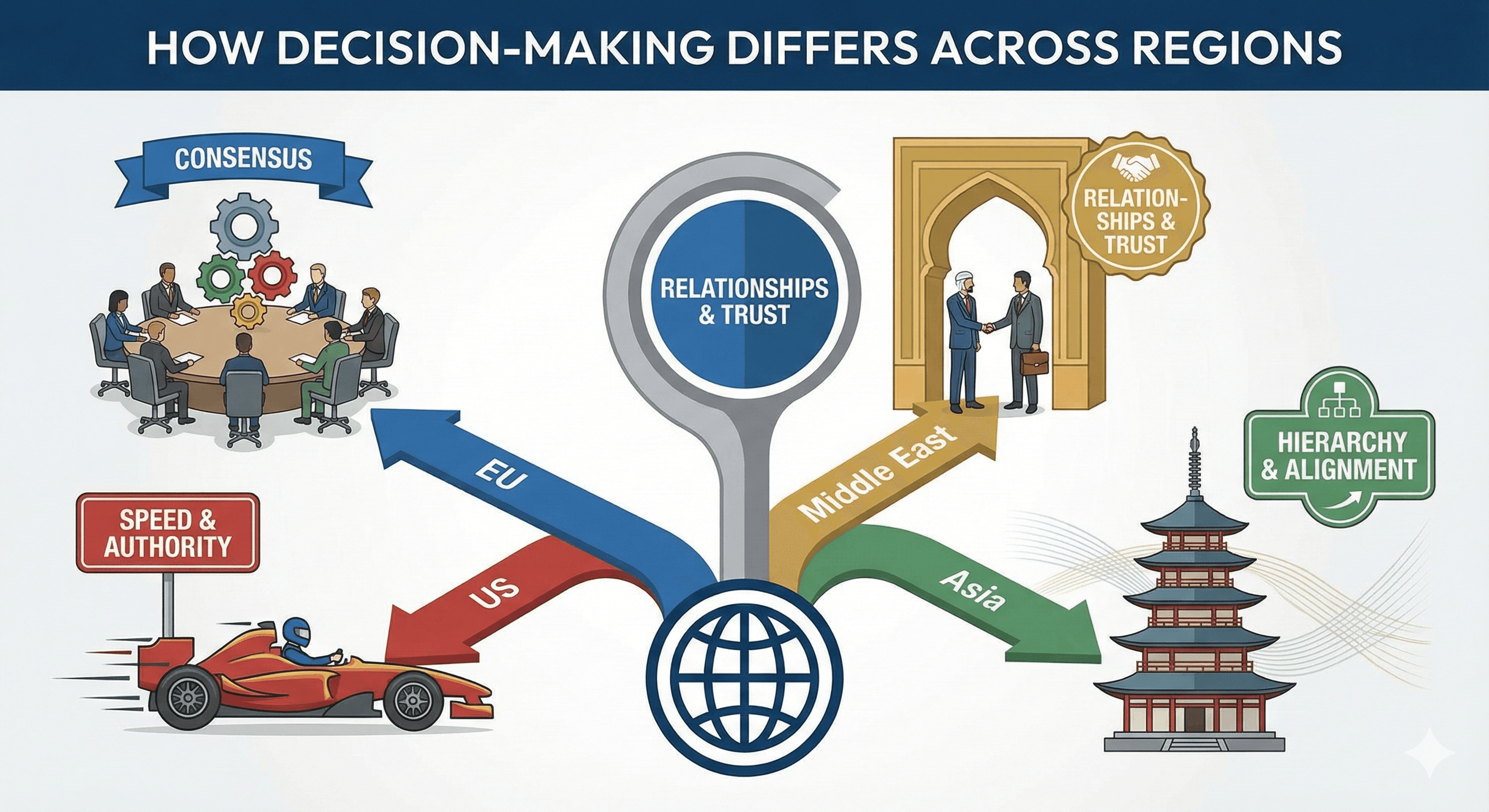
Europe (EU): Consensus and Risk Mitigation
In Europe, decision-making tends to be:
Multi-stakeholder
Structured
Risk-aware
Decisions often require:
Internal alignment
Documentation and validation
Clear long-term rationale
A European “yes” usually means the groundwork has already been done.
Risk: Rushing decisions can undermine trust.
United States: Individual Authority and Speed
In the US, decision-making is often:
Individual-led
Fast
Iterative
Decisions can be made with partial information, with the expectation that details will be refined later.
A US “yes” often means:
“Let’s move forward and adjust as we go.”
Risk: Confusing speed with lack of seriousness.
Middle East: Authority and Relationship-Based Decisions
In the Middle East, decisions are:
Closely tied to senior leadership
Influenced by trust and personal alignment
Long-term once approved
Authority matters. Building trust with decision-makers is critical.
A “yes” here reflects confidence in you, not just your proposal.
Risk: Engaging the wrong level of leadership too early.
Asia: Hierarchy, Alignment, and Indirect Signals
In many Asian markets, decision-making is:
Hierarchical
Deliberate
Communicated indirectly
Decisions often emerge after extensive internal discussion.
Silence may indicate progress, not disengagement.
Risk: Misreading indirect communication and pushing too hard.
Why This Changes Everything
When companies apply their home-market decision logic globally:
Deals stall
Expectations misalign
Momentum is lost
Successful international operators adapt their approach without compromising clarity.
They understand that:
Decision speed ≠ commitment
Silence ≠ rejection
Structure ≠ bureaucracy
Final Thought
Global growth is not just about entering markets.
It’s about learning how decisions are truly made — and respecting those dynamics.
Companies that do this well move faster, with less friction and lower risk.